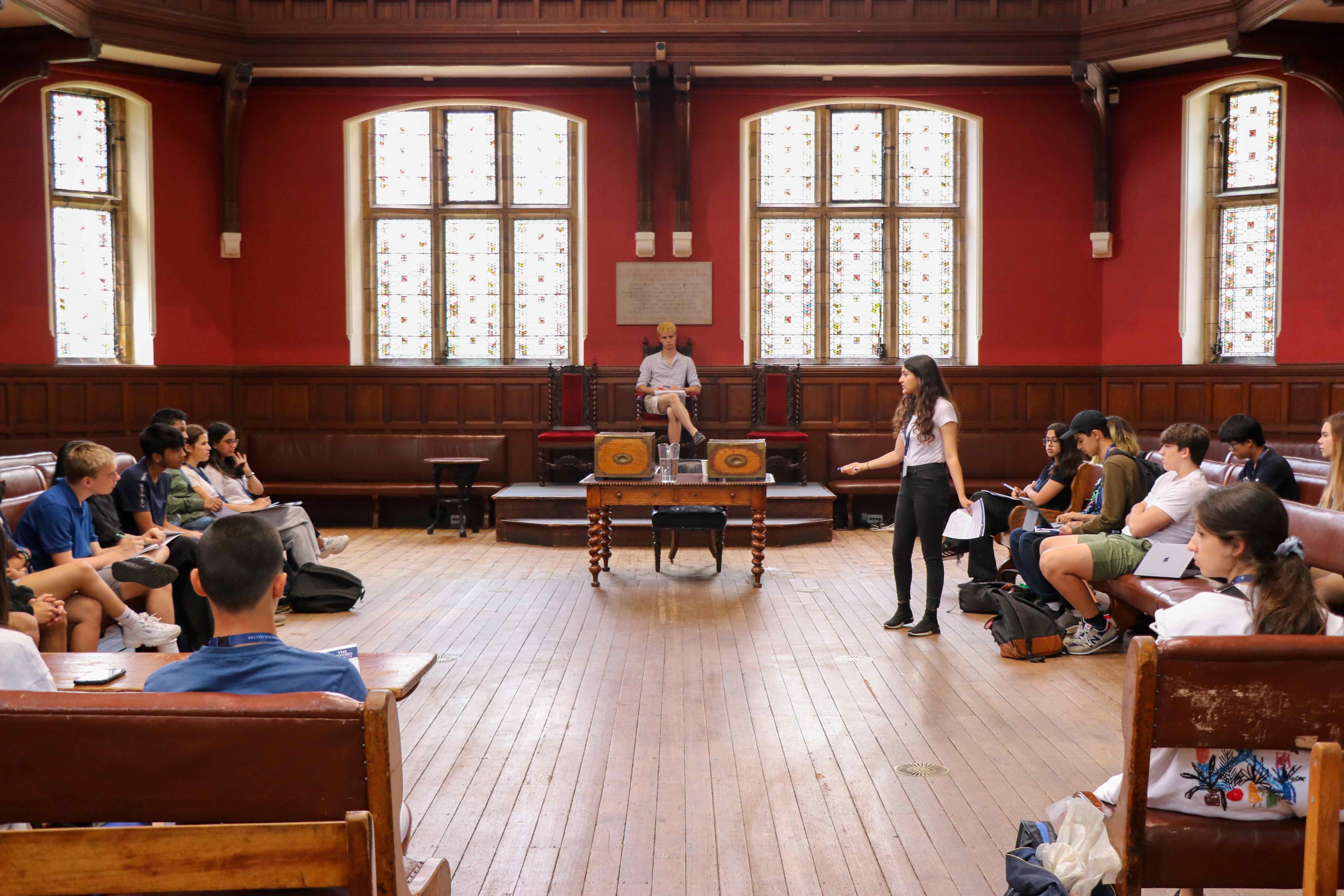
The ability to argue persuasively gives you a decisive advantage in all spheres: academic, professional, and daily life. Therefore, many debating societies around the world try to instill these skills in students. For example, the Oxford Union is a world-famous, prestigious debating society founded at the University of Oxford to uphold free speech. This blog covers the Oxford Union debate format and rules.
Moreover, it offers additional tips to master and polish your debating skills. In fact, at the Oxford Institute, our programs offer debate coaching, and students get to attend Oxford-Union-led workshops as well.
Oxford Union Debate Format and Rules
Oxford Union follows a format and has some important rules you must know. Here is the clear format along with the rules you need to abide by:
The Chairman Sets the Stage
The Chairman is in charge of opening every Oxford Union debate and is addressed as Mr. or Madam Chairman. They briefly discuss the motion, voting procedure, and how floor debates will work. This keeps the entire discussion on track.
Once the rules are clear, the chairman invites the first speaker from the proposition.
The Proposition Opens the Case
The first speaker from the proposition sets the tone and presents their point. Moreover, they also traditionally introduce all speakers, including those of the opposition, and try to get the room on their side early on.
Following the introductions, the real work begins: presenting the motion, structuring the debate, and explaining why the problem is important.
The Opposition Walks in
The first opposition speaker finally walks in and acknowledges the other side. Then he or she does what Oxford debaters love: challenging the points of the other party.
However, note that the objective here is not chaos. Instead, it is to present the same motion from different eyes.
Floor Debates: Everything is Allowed ( Must Align with Chairman's Rules)
This is where the awaiting members in the room join in. They ask questions, test arguments, and challenge the assumptions and ideas of the debator. The audience is now getting directly involved in the debate.
However, there is a time limit, so everyone must speed up.
Second Speakers & Rebuttals: The Strategic Phase
The second speakers from each side now come upon the call of the chairman and build on the points of the first speakers. They also try to eliminate any weaknesses on their side and get stronger.
In addition, they clarify, correct, and land their final points.
This defining feature of the Oxford Union debate format and rules ensures precision at its best.
Both sides can now come with their rebuttals, if any. Usually, each side sends its first speaker to present the rebuttals.
Voting: The Defining Time
At the end, the audience votes for the side they believe in. Note that the most important goal was to convince the audience and get the house on your side throughout the debate.
A Little on Interruptions
Interruptions are allowed but not necessary. Moreover, there are two kinds of interruptions that you will be making: Point of Information and Point of Order.
A Point of Information is made to question a speaker after you get their permission.
A Point of Order is made if there are serious rule breaches, and it is fundamental to hear it.
Some Additional Tips
If you are going to attend or participate in an Oxford Union-style debate, here are some basic tips in addition to the format and rules to help you avoid embarrassment.
Firstly, you must structure your arguments well. It won't be an exaggeration to say that 'structure' will be your best friend in the debating journey.
Arguments should be brief and supported by evidence. It's important to avoid fluff so that you can complete your point on time.
For building a persuasive argument, you should first clearly develop your thesis or main point. Add data, statistics, and expert opinion to support your argument. The stronger the supporting evidence, the harder it gets for the opposition to rebut.
Plus, do note that logical fallacies can be a real game buster, so avoid them. Your logic should be correct, and points must be coherent. It should seem like one point stems from the previous one, and they all flow together perfectly.
Moreover, know that confidence always beats complexity. So, wear it like a crown. Speak as if you believe your argument, because the Oxford audience can quickly detect hesitation. Slow down, take pauses, and let your points land perfectly.
Lastly, always expect an opposing argument to your point and be ready to defend your stance. The best way to achieve this is to follow the earlier points on creating structured, well-supported arguments.
Join our Programmes for Oxford Union-led workshops
The Oxford Institute has been offering programs for passionate students and leaders for many years. These programs are closely associated with Oxford University. In fact, students enrolled in programs such as the Oxford Summer Program and the Oxford Executive Leadership Program live at St. Anne's College, University of Oxford.
The core pillars of our programs, like the Oxford Summer Programme, revolve around Learning, Leadership, and Lifestyle.
Oxford Leadership develops students’ public speaking and leadership skills through Oxford Union-led workshops and mentorship, helping them grow into confident, independent, and engaged young adults.
These are excellent for people who are willing to learn about the Oxford Union debate format and rules directly at Oxford University.
Therefore, if you want to get debating coaching and attend Oxford Union-led workshops, find out more about our programs.
These are a complete package and offer a lot more than just debate coaching. Students can excel academically in their chosen subject areas and have a great overall experience.
The Bottom Line
The Oxford Union debate has a clear format and a defined set of rules. The format assigns roles like the chairman, proposition, and opposition. Additionally, this interactive debating style engages the audience by letting them ask questions and vote for whichever side they find more convincing.
Having structure in your arguments and wearing confidence like a crown can really help you outshine others. Moreover, being ready for rebuttals will allow you to establish your points even further.